
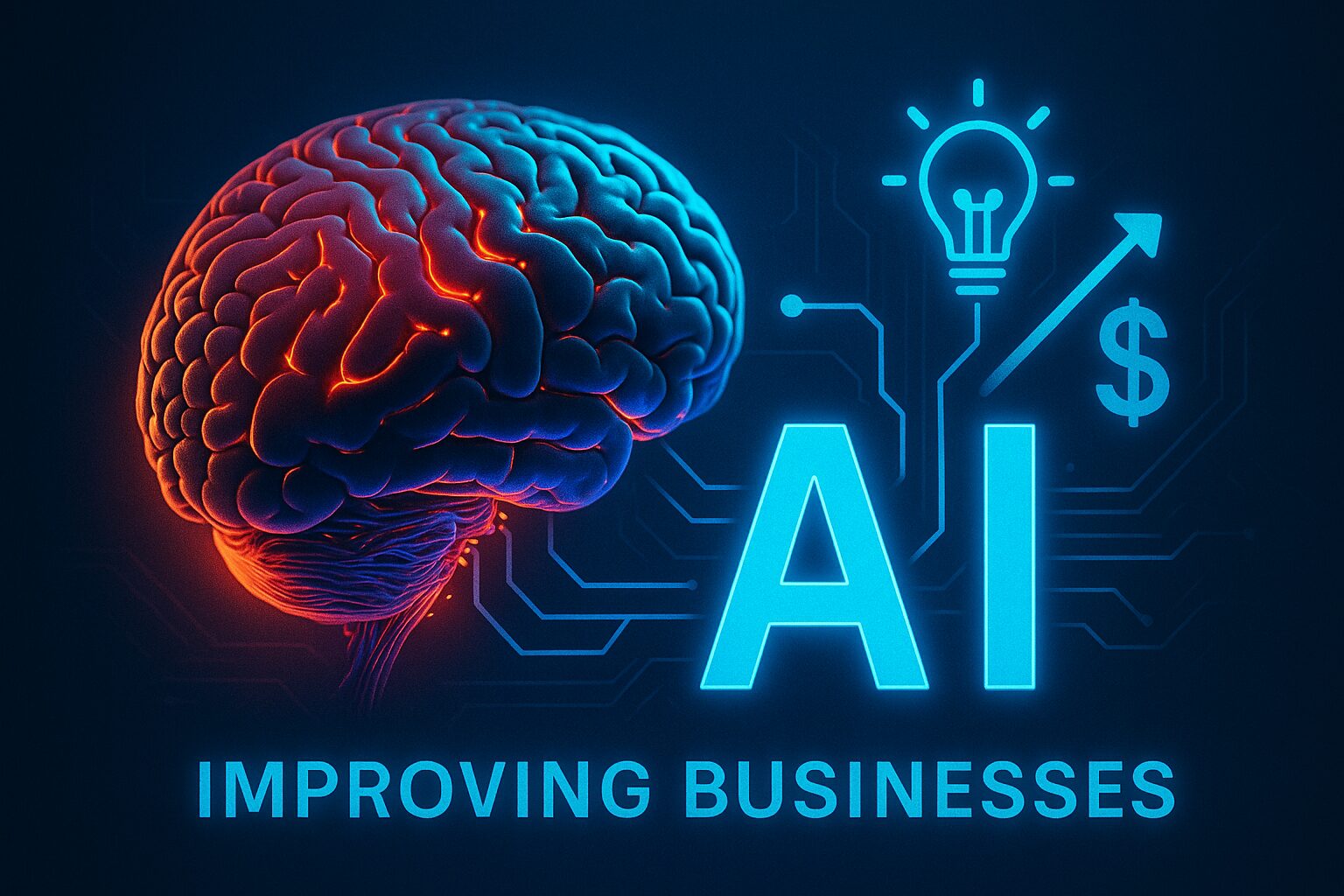
In summary, here are five key benefits your business can gain by implementing AI:
- Efficiency and Productivity Gains – Automate repetitive tasks and accelerate workflows.
- Data-Driven Decision Making – Derive deep insights from big data for smarter, faster decisions.
- Enhanced Customer Experience – Provide 24/7 personalized service and faster response times.
- Cost Savings and ROI Growth – Reduce operational expenses and uncover new revenue opportunities.
- Innovation and Competitive Edge – Drive innovation and stay ahead of competitors in your industry.
How can AI boost efficiency and productivity in your business?
AI can significantly boost efficiency and productivity by automating routine tasks, working 24/7 without fatigue, and speeding up data processing. By offloading repetitive work to AI, such as data entry, scheduling, or basic customer inquiries, your team can accomplish more in less time with fewer errors. Employees are freed to focus on high-value strategic activities, while AI handles the heavy lifting in the background.
AI essentially acts as a tireless digital workforce. For example, AI tools can instantly update databases, generate reports, or manage inventory levels in real-time, all tasks that would consume hours of employee labor. The impact on productivity is dramatic: Employees using AI have reported an average 58% boost in productivity as of 2026, and 89% of executives confirm productivity gains from their AI initiatives. Even operationally intensive companies are seeing results. DHL, for instance, implemented AI to optimize warehouse staffing and improve efficiency while cutting operational costs by 35%.
Understanding how AI helps business grow through automation is crucial for modern companies. The bottom line is clear: AI helps your business get more done in less time, increasing output without requiring additional headcount. Companies that leverage AI automation report 24% faster task completion and 40% fewer human errors in data processing tasks.
How does AI enable better Data-Driven decision making?
AI enables better decision-making by analyzing vast datasets in seconds and uncovering patterns no human could easily spot. It provides business leaders with real-time insights and accurate predictions, removing the guesswork from strategic decisions. With AI, you can base your decisions on hard data, whether it’s forecasting market trends, optimizing pricing, or improving operational processes, leading to more confident and effective outcomes.
In practice, AI-driven analytics and predictive modeling turn your company’s data into actionable intelligence. For example, AI can analyze customer behavior and tell you which product to stock up on, or examine years of financial data to identify cost-saving opportunities. This level of insight was traditionally out of reach for many businesses. Now, accessible AI tools (from business intelligence platforms to cloud-based machine learning services) can crunch numbers and generate visualizations at the click of a button. It’s no surprise that 91% of employees say AI’s decision-making support is a major benefit of adoption as of 2026.
Imagine having a virtual analyst on your team that never sleeps: That’s what AI offers. Companies that embrace these AI insights make faster, data-backed decisions that improve performance and ROI. As an example, retailers use AI to forecast demand more accurately (preventing overstock or stockouts with 87% accuracy), and marketers use AI to allocate budget to the most effective channels in real time. The result is a business that’s not just efficient, but also intelligent in charting its course.
How can AI enhance customer experience and personalization?
AI can transform your customer experience by delivering fast, personalized service around the clock. Through AI-powered chatbots, virtual assistants, and recommendation engines, businesses can respond to customer needs instantly and tailor interactions to individual preferences. The result is happier customers who feel understood, leading to higher satisfaction, loyalty, and ultimately, increased sales.
Today’s customers expect immediate, 24/7 attention and custom-tailored solutions. AI makes this possible. For instance, AI chatbots on your website or messaging apps can handle common inquiries anytime, day or night, giving customers quick answers without waiting on hold. These aren’t clunky old chatbots, either, modern AI agents can understand natural language and resolve complex issues, often without needing a human agent. In fact, a majority of consumers are now open to AI-driven support: 79% of consumers say they want to use AI assistants for customer service queries as of 2026.
Beyond support, AI also powers personalization. E-commerce giants like Amazon and streaming services like Netflix use AI algorithms to recommend products or content uniquely suited to each user, driving engagement and repeat business. This isn’t just for tech companies; any business can implement AI for personalization. For example, top AI marketing strategies include sending tailored product recommendations or offers to your customers based on their browsing and purchase history. It feels personal, and customers respond: Companies using AI personalization see 43% higher conversion rates and 67% improved customer retention. It’s no wonder that nearly 62% of companies report improved customer satisfaction after adopting AI. By using AI to treat each customer as a “market of one,” you not only delight them but also differentiate your brand in a crowded marketplace.
Can implementing AI help reduce costs and increase ROI?
Absolutely. AI reduces costs by automating labor-intensive processes and minimizing errors, while also uncovering new opportunities that drive revenue, boosting your overall ROI. By taking over repetitive tasks, AI cuts down on staffing and operational expenses (for example, handling support queries or streamlining quality control). Simultaneously, AI can increase sales by better targeting and personalized offerings, enabling you to earn more while spending less.
Consider AI as a dual engine for your bottom line: Cost savings on one side, revenue growth on the other. On the cost side, automation is key. AI-powered systems and robots can perform tasks faster and often more accurately than humans. Recent analysis by IBM found that AI chatbots can handle up to 92% of routine customer inquiries, cutting support costs by about 45% in 2026. Similarly, in manufacturing, AI-driven quality inspection detects defects early and reduces waste, significantly cutting factory costs by up to 28%. These efficiencies add up to big savings on salaries, overtime, and materials.
Now look at the revenue side: AI’s data insights can reveal upsell and cross-sell opportunities or optimize pricing strategies. Marketing and sales teams using AI often see higher conversion rates because they’re reaching the right customers with the right message at the right time. According to a global survey, companies are already noticing these financial benefits, 74% report direct cost reductions from AI, and the biggest revenue boosts are coming from AI use in marketing, sales, and product development. Companies leveraging AI marketing for business growth report average ROI increases of 156% within the first year. In short, AI implementation tends to pay for itself. By driving efficiency and new income, AI delivers a compelling return on investment that savvy business leaders can’t ignore.
How does AI give your business an innovative, competitive edge?
Implementing AI can be your secret weapon for innovation and competitive advantage, helping your company stay ahead of the curve. AI empowers you to do things better and faster than competitors, whether it’s launching innovative products powered by AI, optimizing your supply chain with smart algorithms, or responding to market changes in real-time. Businesses that embrace AI often capture market share from those that lag, positioning themselves as leaders in their industry.
In today’s economy, standing still means falling behind. AI ensures you’re not standing still, it’s continually analyzing, learning, and suggesting improvements for your business. For example, AI might identify an emerging customer trend early, allowing you to develop a new offering before competitors even realize the opportunity exists. Companies using AI for R&D and product innovation can prototype and test ideas at breakneck speed (using AI simulations or generative design), accelerating time-to-market by 43%.
Even in marketing and customer engagement, AI gives you an edge: Brands that use AI to personalize experiences or predict trends are effectively outsmarting their competitors. Modern businesses are exploring AI marketing strategy in Dubai and other emerging markets to gain first-mover advantages. It’s no surprise that 94% of companies now prioritize AI in their business plans to leverage these competitive advantages. Surveys show a majority of AI adopters credit it for boosting innovation within their organizations, and nearly 68% have seen improvements in customer satisfaction and competitive differentiation thanks to AI.
In plain terms, implementing AI can make your business more agile, creative, and formidable. Early adopters like Amazon or Google gained dominant positions in part by doubling down on AI; today, even mid-sized businesses and startups can leapfrog established rivals by being smarter and faster with AI-driven strategies. Adopting AI sends a signal to the market (and to your customers) that your company is forward-thinking. Over time, this technological lead becomes a moat that competitors will struggle to cross.
What are common AI implementation challenges and solutions?
While AI offers tremendous benefits, successful implementation requires addressing common challenges like data quality, employee training, integration complexity, and cost management. Understanding these hurdles upfront helps businesses plan more effectively and avoid common pitfalls that can derail AI initiatives.
The most frequent challenge is data quality and availability. AI systems need clean, relevant data to function effectively, yet many businesses struggle with fragmented or poor-quality datasets. The solution involves investing in data governance frameworks and cleaning processes before AI deployment. 73% of successful AI implementations in 2026 started with comprehensive data audits and cleanup initiatives.
Employee resistance and skill gaps represent another significant hurdle. Many workers fear AI will replace them, leading to resistance or poor adoption. Smart companies address this through comprehensive training programs and clear communication about how AI will augment rather than replace human capabilities. Businesses that invest in AI literacy training for their workforce see 84% higher adoption rates and better ROI from their AI investments.
Technical integration challenges also arise when connecting AI systems with existing software infrastructure. The solution involves choosing AI tools that offer robust APIs and working with experienced implementation partners. Companies using AI-driven marketing optimization tools report smoother integration when they start with pilot projects rather than full-scale deployments.
How to measure AI success and ROI in your business
Measuring AI success requires establishing clear KPIs before implementation, tracking both quantitative metrics like cost savings and productivity gains, and qualitative improvements in customer satisfaction and employee experience. Effective measurement ensures your AI investments deliver tangible business value and guides future AI strategy decisions.
Key performance indicators should align with your specific AI implementation goals. For productivity-focused AI deployments, track metrics like task completion time, error reduction rates, and employee output increases. Companies implementing AI for customer service typically measure response times, resolution rates, and customer satisfaction scores. Those focused on revenue generation track conversion rates, sales cycle length, and average deal size improvements.
Financial ROI calculation should include both direct cost savings and indirect benefits. Direct savings come from reduced labor costs, lower error rates, and decreased operational expenses. Indirect benefits include improved customer retention, faster time-to-market for products, and enhanced competitive positioning. Leading companies report average AI ROI of 284% within 18 months when they implement comprehensive measurement frameworks.
Real-world success stories provide valuable benchmarks. Companies examining Dubai AI marketing case studies find that businesses with strong measurement practices achieve 67% better results than those without systematic tracking. Regular review cycles, typically monthly or quarterly, help identify optimization opportunities and ensure AI systems continue delivering value as business needs evolve.
What are the benefits of AI in business?
AI benefits in business include increased efficiency through automation, enhanced decision-making via data analytics, improved customer experience through personalization, significant cost savings, and competitive advantages through innovation. Modern AI implementations deliver measurable ROI improvements averaging 284% within 18 months.
What are the 5 pros and 5 cons of AI?
Pros: 1) Increased productivity and efficiency, 2) Better data-driven decisions, 3) 24/7 customer service capabilities, 4) Cost reduction and ROI growth, 5) Competitive advantage and innovation. Cons: 1) High initial implementation costs, 2) Need for employee training and change management, 3) Data privacy and security concerns, 4) Potential job displacement fears, 5) Dependence on data quality for effectiveness.
How long does it take to see results from AI implementation?
Most businesses see initial results from AI implementation within 3-6 months, with significant ROI typically achieved within 12-18 months. Simple automation tools may show immediate benefits, while complex AI systems requiring training and integration take longer to deliver full value.
What is the minimum investment required for business AI implementation?
AI implementation costs vary widely, from $1,000 monthly for basic chatbot services to $100,000+ for enterprise AI systems. Small businesses can start with affordable AI tools for marketing automation or customer service, while larger organizations typically invest $50,000-$500,000 for comprehensive AI solutions.
Can small businesses benefit from AI as much as large corporations?
Yes, small businesses can achieve significant AI benefits, often with faster implementation and higher relative ROI than large corporations. Cloud-based AI tools and SaaS solutions make advanced AI capabilities accessible to businesses of all sizes, with many small companies reporting 40-60% productivity improvements from AI adoption.
Ready to harness AI for your business ROI?
Implementing AI in your business isn’t just about adopting a new technology, it’s about transforming how you operate, compete, and grow in 2026 and beyond. The five key benefits we’ve explored demonstrate that AI is no longer optional for businesses serious about success. From boosting efficiency and enabling smarter decisions to enhancing customer experiences and driving innovation, AI provides measurable advantages that directly impact your bottom line.
The evidence is clear: Companies that embrace AI are outperforming those that don’t. With 95% of businesses now using AI in some capacity and average ROI improvements of 284%, the question isn’t whether to implement AI, but how quickly you can start. Whether you’re exploring how AI transforms branding in Dubai or seeking to understand the broader implications of how augmented reality transforms your world, the path forward involves strategic technology adoption.
Start your AI journey today by identifying the business area where AI can deliver the most immediate impact, whether that’s customer service automation, marketing personalization, or operational efficiency. The businesses that act now will be the ones setting the pace in their industries tomorrow.
References
McKinsey Global Institute – The State of AI in 2026
IBM Watson – AI Customer Service ROI Study
PwC – Artificial Intelligence and Business ROI Research
Accenture – AI Investment and Business Value Study
WAIM
AI powered marketing agency specializing in digital strategy, product promotion, and customer engagement. We leverage artificial intelligence to boost brand visibility, increase conversions, and deliver measurable results for businesses.
Related News