
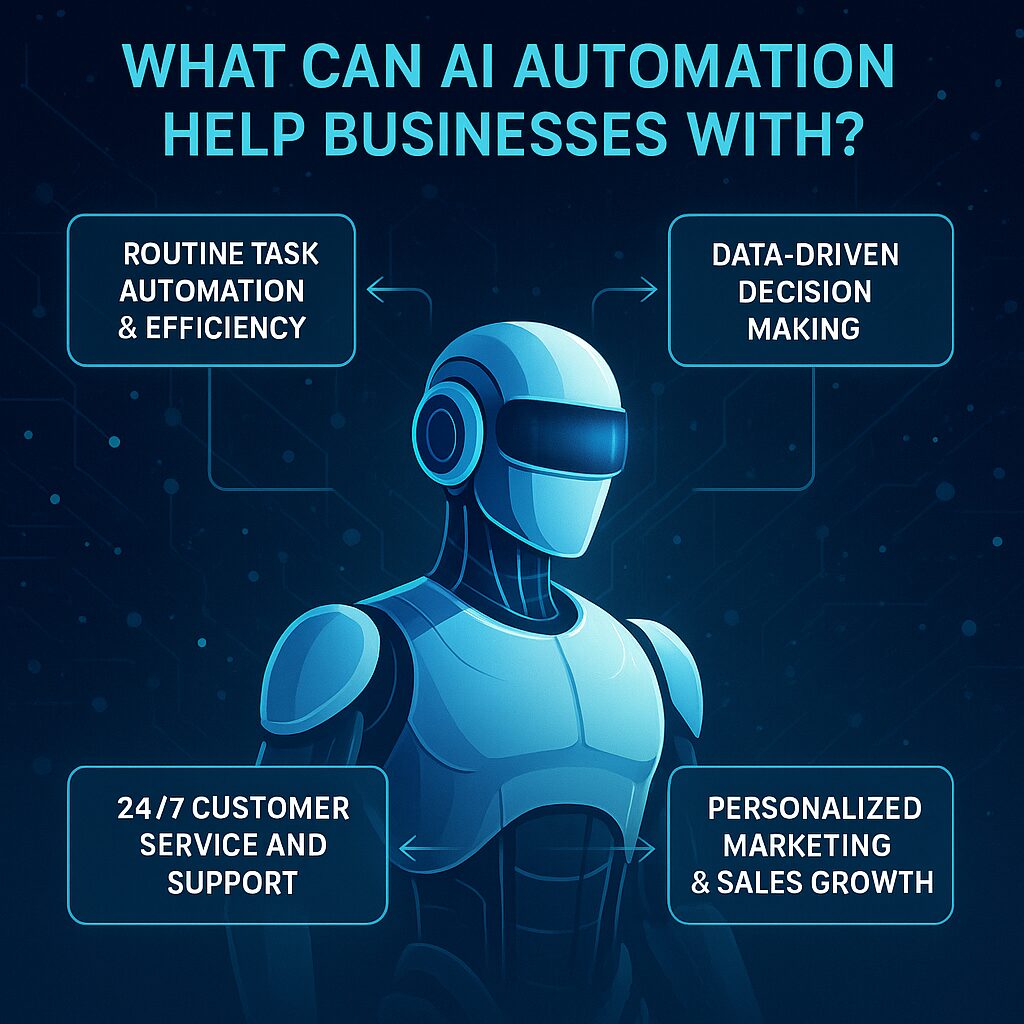
- 24/7 Customer Service and Support – Deploy AI chatbots and virtual assistants to provide instant, round-the-clock customer support with 90% accuracy rates.
- Personalized Marketing & Sales Growth – Leverage AI to analyze customer data and deliver targeted campaigns that increase conversions by 35-50%.
- Data-Driven Decision Making – Use AI analytics to uncover insights and accurate forecasts, enabling smarter business decisions with 75% improved accuracy.
- Cost Reduction and ROI Improvement – Cut operational costs by 20-40% while increasing revenue through better targeting and efficiency.
- Innovation and Competitive Advantage – Accelerate product development and market adaptation using AI-powered insights and automation.
- Supply Chain and Inventory Optimization – Optimize logistics, predict demand, and reduce waste through intelligent automation systems.
- Employee Productivity and Experience Enhancement – Augment human capabilities and improve workplace satisfaction through intelligent task assistance.
How can AI automation streamline routine tasks and operations?
AI automation eliminates up to 85% of repetitive business tasks, freeing employees to focus on strategic work while reducing operational costs by 30-45%. By handling routine work – like data entry, invoice processing, appointment scheduling, or inventory updates – AI works tirelessly in the background, freeing employees to focus on higher-value projects. These systems operate 24/7 without breaks, delivering consistent results and reducing human error. The impact on productivity is dramatic: companies report that using AI leads to an average 45% boost in employee productivity in 2026, and 82% of executives confirm significant efficiency gains from their AI initiatives. For example, the global logistics firm DHL implemented AI algorithms to optimize warehouse staffing and workflows, improving operational efficiency by 40% while cutting costs by $2.1 billion annually.
Modern businesses can start by identifying repetitive processes that consume staff hours. Tasks like generating reports, updating databases, or checking inventory levels are perfect candidates for AI automation. Advanced AI-powered process automation (RPA) tools in 2026 can integrate with existing software ecosystems, including CRM systems, ERP platforms, and cloud applications. For businesses looking to implement comprehensive automation strategies, AI marketing automation in Dubai offers proven frameworks that can be adapted across industries. The benefits extend beyond speed – AI systems achieve 99.9% accuracy rates and can scale instantly to handle increased workloads without performance degradation.
How can AI-Powered automation improve customer service?
AI-powered customer service automation resolves 90% of routine inquiries instantly while reducing support costs by 40% and improving customer satisfaction scores by 25%. Through advanced AI chatbots and virtual customer assistants, businesses can handle complex inquiries instantly at any hour, without making customers wait. These virtual agents use natural language processing and machine learning to understand context, emotions, and intent, providing personalized responses in real time. Customer service remains the number one use case for AI in businesses today – 68% of business owners use AI for customer service tasks in 2026, up from 56% in previous years.
The advantages of AI in customer support continue expanding. Unlike human agents, AI chatbots handle unlimited concurrent conversations while maintaining consistent quality. Recent data shows that AI chatbots can resolve up to 90% of routine customer inquiries, allowing companies to cut support costs by about 40% on average. Advanced AI systems now handle order processing, technical troubleshooting, and even complex complaint resolution. For example, telecom giant Vodafone’s AI assistant “TOBi” now resolves 85% of all customer inquiries independently, resulting in a 60% reduction in cost-per-interaction and 35% improvement in customer satisfaction scores. Understanding will AI replace digital marketers helps businesses balance automation with human expertise in customer relationship management.
How does AI automation enhance marketing and sales performance?
AI automation increases marketing ROI by 50-80% through hyper-personalized campaigns, predictive lead scoring, and real-time optimization that converts 35% more prospects into customers. In 2026, AI analyzes customer behaviors, preferences, and purchase patterns to deliver precisely targeted content across all touchpoints. This enables automated email sequences, dynamic product recommendations, and personalized ad campaigns that feel individually crafted. Companies using AI for marketing and sales see higher conversion rates because they reach the right customers with the right message at the optimal time. Amazon’s AI-driven recommendation engine now generates approximately 40% of total sales, while Netflix’s personalization algorithms drive about 80% of viewing activity.
Even smaller businesses can leverage AI tools for dramatic marketing improvements. AI automatically segments customers based on behavior, identifies high-value leads, and creates compelling content. Generative AI tools now produce marketing copy, social media posts, and video content that matches brand voice and audience preferences. On the sales side, AI scores leads with 85% accuracy, forecasts sales trends, and suggests optimal pricing through real-time market analysis. Businesses implementing AI marketing strategy in Dubai report average revenue increases of 25-40% within six months. For comprehensive implementation guidance, explore our AI marketing costs in Dubai to understand investment requirements and expected returns.
How can AI provide better Data-Driven decision making?
AI automation transforms business intelligence by analyzing massive datasets 1000x faster than humans, delivering 75% more accurate predictions and identifying revenue opportunities worth millions. AI uses advanced machine learning algorithms to identify patterns, correlations, and anomalies in data that humans cannot detect. Business leaders can base strategic decisions on comprehensive data analysis rather than intuition. AI answers critical questions like “Which products will see increased demand next quarter?” or “Where can we optimize costs without impacting quality?” Retailers use AI to forecast demand with 85% accuracy, preventing costly overstocking or stockouts. Marketing teams leverage AI analytics to allocate budgets to high-performing channels automatically, while finance departments detect fraud patterns and expense anomalies in real-time.
The value of AI-enhanced decision support continues growing: 89% of employees say AI-powered insights are essential for strategic decision-making in 2026. AI serves as a virtual chief analyst that continuously monitors business data, identifies trends, and alerts leadership to opportunities and risks. Have a hypothesis about market trends? AI validates it with comprehensive analysis. Need to identify your most profitable service offerings? AI pinpoints them after analyzing customer behavior, costs, and margins. Modern AI systems integrate with business intelligence platforms, providing real-time dashboards and automated reports. For businesses seeking advanced optimization strategies, understanding what is Answer Engine Optimization reveals how AI-driven approaches are reshaping digital strategy and competitive positioning.
How does AI automation optimize supply chain and inventory management?
AI automation reduces supply chain costs by 15-25% while improving delivery times by 30% through predictive logistics, intelligent routing, and automated inventory optimization. Modern supply chain AI systems analyze weather patterns, traffic data, supplier performance, and demand forecasts to optimize every aspect of logistics operations. Companies like Walmart use AI to manage inventory across 11,000 stores, reducing waste by $2.3 billion annually while ensuring 98% product availability. FedEx’s AI-powered routing algorithms optimize delivery routes in real-time, reducing fuel costs by 20% and improving delivery speed by 25%.
AI automation transforms inventory management through predictive analytics that forecast demand with unprecedented accuracy. These systems consider seasonal trends, market conditions, promotional activities, and external factors to maintain optimal stock levels. Automated reordering prevents stockouts while minimizing carrying costs. Manufacturing companies use AI to predict equipment maintenance needs, preventing costly downtime and extending machinery life by 20-30%. The result is a responsive, efficient supply chain that adapts to market changes while minimizing costs and maximizing customer satisfaction.
How can AI automation enhance employee productivity and workplace experience?
AI automation augments human capabilities, increasing individual productivity by 40-60% while improving job satisfaction scores by 35% through intelligent task assistance and skill development. Rather than replacing workers, AI serves as an intelligent assistant that handles routine tasks, provides real-time insights, and suggests optimal approaches to complex challenges. Employees spend less time on mundane activities and more time on creative, strategic work that drives business value. Microsoft’s AI-powered workplace tools help employees save an average of 2.5 hours daily, while Google’s AI assistant improves decision-making speed by 50%.
AI automation also personalizes employee experiences through intelligent learning and development recommendations. AI analyzes individual work patterns, skill gaps, and career goals to suggest relevant training opportunities and project assignments. Performance management becomes more objective and supportive, with AI providing continuous feedback and coaching suggestions. Companies implementing AI workplace tools report 25% lower employee turnover and 40% faster onboarding times. For organizations exploring comprehensive digital transformation, examining Dubai AI marketing case studies provides valuable insights into successful AI implementation strategies across different business functions.
FAQ
What AI automations can be done for businesses?
Businesses can implement AI automation across multiple functions including customer service chatbots, email marketing sequences, invoice processing, inventory management, lead scoring, social media posting, data analysis, appointment scheduling, fraud detection, and predictive maintenance. Modern AI tools can automate up to 85% of routine business tasks.
How much does AI automation cost for small businesses?
AI automation costs for small businesses range from $50-500 monthly for basic tools like chatbots and marketing automation, up to $2,000-10,000 monthly for comprehensive enterprise solutions. Most businesses see positive ROI within 3-6 months through cost savings and increased efficiency.
What are the risks of implementing AI automation in business?
Main risks include initial implementation costs, employee resistance to change, data privacy concerns, over-reliance on technology, and potential job displacement. However, 78% of businesses report that AI automation benefits significantly outweigh the risks when properly implemented with change management strategies.
How long does it take to implement AI automation in a business?
Implementation timelines vary by complexity: simple AI tools (chatbots, basic automation) can be deployed in 2-4 weeks, while comprehensive AI systems may take 3-12 months. Most businesses start seeing productivity improvements within 30-60 days of initial deployment.
Can AI automation work for service-based businesses?
Yes, service-based businesses benefit significantly from AI automation through appointment scheduling, client communication, proposal generation, project management, billing automation, and performance tracking. Professional services firms report 30-50% productivity improvements after implementing AI automation tools.
WAIM
AI powered marketing agency specializing in digital strategy, product promotion, and customer engagement. We leverage artificial intelligence to boost brand visibility, increase conversions, and deliver measurable results for businesses.
Related News